#27 - Kyle Lacy
Kyle Lacey is the CMO of Docebo, a public learning and development software company with 800+ employees, but he's not a traditional big-company marketer. He came up as a content marketer, built his own audience to 60,000+ followers on LinkedIn, and actually understands how digital content works today. He tells us all about through the four buckets he uses to run content at a company this size: market and external comms, employee advocacy, executive thought leadership, and benchmarking and research. We get into how he budgets and measures what’s working, why he’s more bullish on employee-led content than most CMOs, how to help execs post consistently when time is the real constraint, and why he believes the last differentiator in a world where everyone has AI is your people.
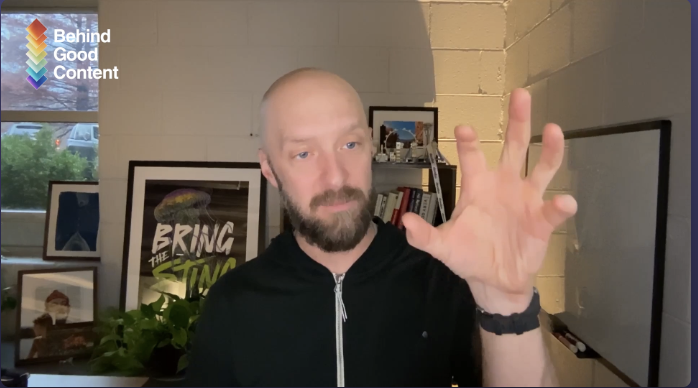
This week, I sat down with Kyle Lacy, who runs marketing at Docebo, a publicly traded SaaS company with hundreds of millions in revenue.
“My opinion on how content should be produced hasn’t changed since I ran content marketing in 2012.”
Kyle’s perspective is grounded in a simple idea: the tools change, but the best source of information doesn’t.
That source?
People.
Good content has always come from real people with real points of view. Everything else follows behind. When we talked about AI and what it’s good for, he made a strong claim that I 100% agree with:
“When everyone has AI tooling, the only competitive advantage you have are your humans.”
Well said.
Kyle’s four content pillars
With people as the primary source material, Kyle groups content types into four categories. He’s used some version of these for more than a decade, and they’re the same buckets he’s working from now as a CMO.
1. Market and external communications
This is the outward-facing narrative: corporate communications, strategic media, content that shapes market perception.
Docebo is a public company, so this layer matters. But even in smaller organizations, this is where you’re defining how the market understands who you are and what you stand for.
2. Executive thought leadership
This is a pillar growing in popularity in most B2B organizations. While most leaders agree that it’s important, teams are still negotiating how to get their execs to produce meaningful content sustainably.
Kyle was clear that this takes time, systems, and pacing. We joked about how, at first, executives love the likes and comments, but the fun can fizzle out fast. Keeping this pillar alive is hard work but definitely worth it.
3. Benchmarking and research
Original data is a great way to build authority and, because of its proprietary nature, it’s pretty hard to duplicate. AI chatbots are certainly not coming up with the compelling research that organizations can compile from internal data.
I think this is a pillar worth seriously investing in, but would push the scope beyond just benchmarks and research. There are a lot of ways you can leverage your proprietary data to earn organic reach (see Peter Walker), and earned media (see Jason Saltzman).
4. Employee alignment and advocacy
This is the pillar Kyle believes most companies underinvest in.
“You have an entire group of people that work for you — the majority of them love what you do. Why not leverage them appropriately?”
I was curious to learn more about this last piece.
The opportunity in employee content
At one point, I asked Kyle how emphatic he is that executive thought leadership becomes a more formal budget line item. He said that he is bullish on exec content, but even more bullish on employee content.
“Many of your employees have small networks of powerful people. Not to mention, who’s talking to people in your business’s market the most? The employees.”
Traditionally, when I think of employee content, I think of a hundred employees posting the same eyeroll-invoking product launch post.
But that’s not what Kyle’s talking about.
Kyle thinks companies should help their employees share their own perspectives and experiences, with a quiet undercurrent of this is the work we do here.
“This is not about buying a tool that amplifies a message by like a hundred people. When you see 20 posts from employees that are all the same, it’s disingenuous. It doesn’t work.”
To put this pillar in motion, Kyle looks for people who are already active, engaged, and close to the market.
One example he shared was about an employee named Harold, an account manager deeply interested in learning and development. Docebo is supporting Harold in relaunching his own podcast and newsletter. And it has zero corporate branding.
“It has no tie-back to Docebo, but we’re supporting him in the endeavor because he’s talking to the market now.”
Harold’s podcast is about connection and credibility. It’s not a channel that’s built to drive direct traffic. And frankly, Kyle finds a lot of value in Docebo employees investing in their own personal brand. Not everything needs to circle back to the company’s POV — and in fact, it shouldn’t.
“If you’re only focused on company messaging, you’re not going to be that passionate about it.”
My chat with Kyle boils down to one main idea:
The tools will keep changing and the volume of content online will keep growing, but the compounding advantage still stays the same.
“If you are not including human beings, you’re going to be like everyone else.”
.jpg)
.jpg)
.jpg)
%20(1).gif)
.gif)
.gif)
%20(1).gif)

