#29 - Noah Greenberg
Noah Greenberg is the CEO of Stacker, a platform that helps brands turn original, editorial content into earned distribution across thousands of news outlets. He tells us all about the shift happening in B2B marketing: companies are hiring journalists and editorial leaders instead of traditional content marketers, because the old acquisition playbook is saturated and brand matters again. Noah breaks down why “newsroom” thinking is showing up inside more companies, what distribution looks like when you treat owned content like earned media, and how Stacker became infrastructure that connects brands producing high-quality stories with publishers that need more content.
.jpg)
Hey all,
This week on Behind Good Content, I sat down with Noah Greenberg, Founder and CEO of Stacker.
Noah’s been tracking a major shift that’s been picking up speed throughout 2025 and into 2026.
“We are seeing is brands building out newsrooms in an effort to not just try and get covered by the news, but to actually be a source of information in their industry,” Noah said.
That single idea explains a lot of what’s changing in content right now, and why “brand” is sitting on top of the priority list this year.
Why media brand marketing is suddenly everywhere
For much of the last 20 years, customer acquisition costs were cheap.
“If you had a spreadsheet monkey that could figure out how to optimize for clicks, then you could drive business… and you didn’t really need to build a brand.”
But over time, those channels got crowded and expensive. It became easier to start companies, which meant more competitors fighting for the same demand. AI is accelerating these low barriers to entry.
That’s why it’s becoming more and more important to build brand.
“The channels that were working got saturated… and that made brand really important again. And what helps build brand is content.”
How brands are building audiences like media companies
Noah sees three distinct models for how companies can effectively build a media brand:
1) The media company model (build or buy)
What it is: You create (or acquire) a true media brand—newsletter, podcast network, editorial team—and grow it the same way any publisher grows a media property.
How it works: You’re not using content to support marketing. In this model, content actually becomes the product that builds attention and trust, and the business benefits by being adjacent to that attention.
Noah shared a couple of examples, including Hubspot buying The Hustle and Robinhood building Sherwood Media.
This is the “go big” model.
2) The newswire model (owned → earned at scale)
What it is: You publish strong editorial content on your site, but instead of relying on SEO or social to bring readers to you, you push that content out into other publications like a modern syndicated column.
Noah called out Zillow and NerdWallet as the “godfathers” of this strategy.
“Instead of trying to just get readers to their site, they became news wires and essentially gave that content away to news outlets all over the country.”
Why it’s powerful: This model lets businesses reach audiences that would never visit their site without the huge investment of media company building or acquisition. It’s a lot more accessible for mid-size teams, while still building huge amounts of credibility for the business.
3) The personality-led model (LinkedIn as the publication)
What it is: In this model, the “media property” is a person—founder, exec, or internal subject matter expert—who publishes consistently, builds an audience, and becomes a go-to source in the category.
Examples of this model are the heavy hitters on LinkedIn:
- Peter Walker at Carta
- Aura Kharazian at Ramp
- Sam Jacobs at Pavilion
The key is to think of your people as individual distribution channels. They are a unique outlet building their own unique audience. In today’s digital media landscape, content from individuals can outperform content from brands 5-10X.
The skill shift behind media brand marketing
Every distribution method is united by one driving question:
How do we become a trusted source of information?
And, for Noah, the answer is in the hiring.
Noah said one of the clearest signals over the last year is where content orgs are headed from a hiring perspective; more brands are staffing content teams with journalists, storytellers, and reporters. If you follow Noah on LinkedIn, you’ll see what he means. His feed has basically turned into a running list of companies recruiting for editorial roles.
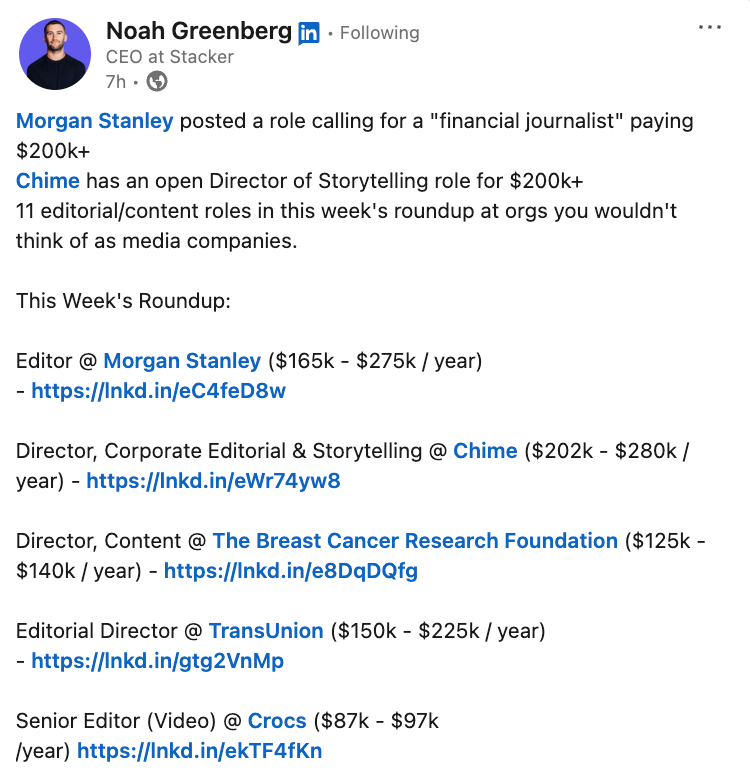
The logic is pretty straightforward. Most B2B content marketing is shaped around internal priorities: ranking, converting, tightening up product perception, arming the sales team.
But a media brand strategy has a different standard. The content has to hold up as information someone would trust even if they aren’t looking to buy.
That’s the job journalists are trained for. They’re good at figuring out what a reader actually wants to understand and presenting it in a way that doesn’t feel anywhere close to a pitch.
No matter which distribution model you use, this level of credibility is non-negotiable. Even in individual storytelling content like the third model, it’s pivotal that thought leaders stay away from direct selling.
The TL;DR is this: if the goal is to become a trusted source, the work starts by building the editorial muscle—and increasingly, that means hiring for it.
.jpg)
.jpg)
.jpg)
%20(1).gif)
.gif)
.gif)
%20(1).gif)

