#36 - Eleanor Warnock
Eleanor Warnock is the managing director at Every, a media and software company at the cutting edge of AI. Every has automated as much as it can, built agents into the way the company works, and become a real model for what an AI-native company can look like. But Eleanor’s recent piece, “Socrates as a Service,” makes a case for one skill that AI still can’t replace: the interview. She tells us all about why the best stories still need a human to uncover them, what makes interviewing such an important skill in the age of AI, and why “extraction” is becoming more valuable as execution gets easier. We also get into her own process as a writer and editor, how she uses Claude without handing over the writing itself, and why the scarce thing now is not more content, but better questions.
.jpg)
Hey all,
In 2021, Elon Musk gave YouTuber Tim Dodd a tour of the SpaceX Starbase.
In the middle of a discussion about the rocket’s booster, Tim asked Elon a seemingly innocuous question about the system. But that question stopped Elon dead in his tracks. It made him scrap and rethink the spaceship’s entire design.
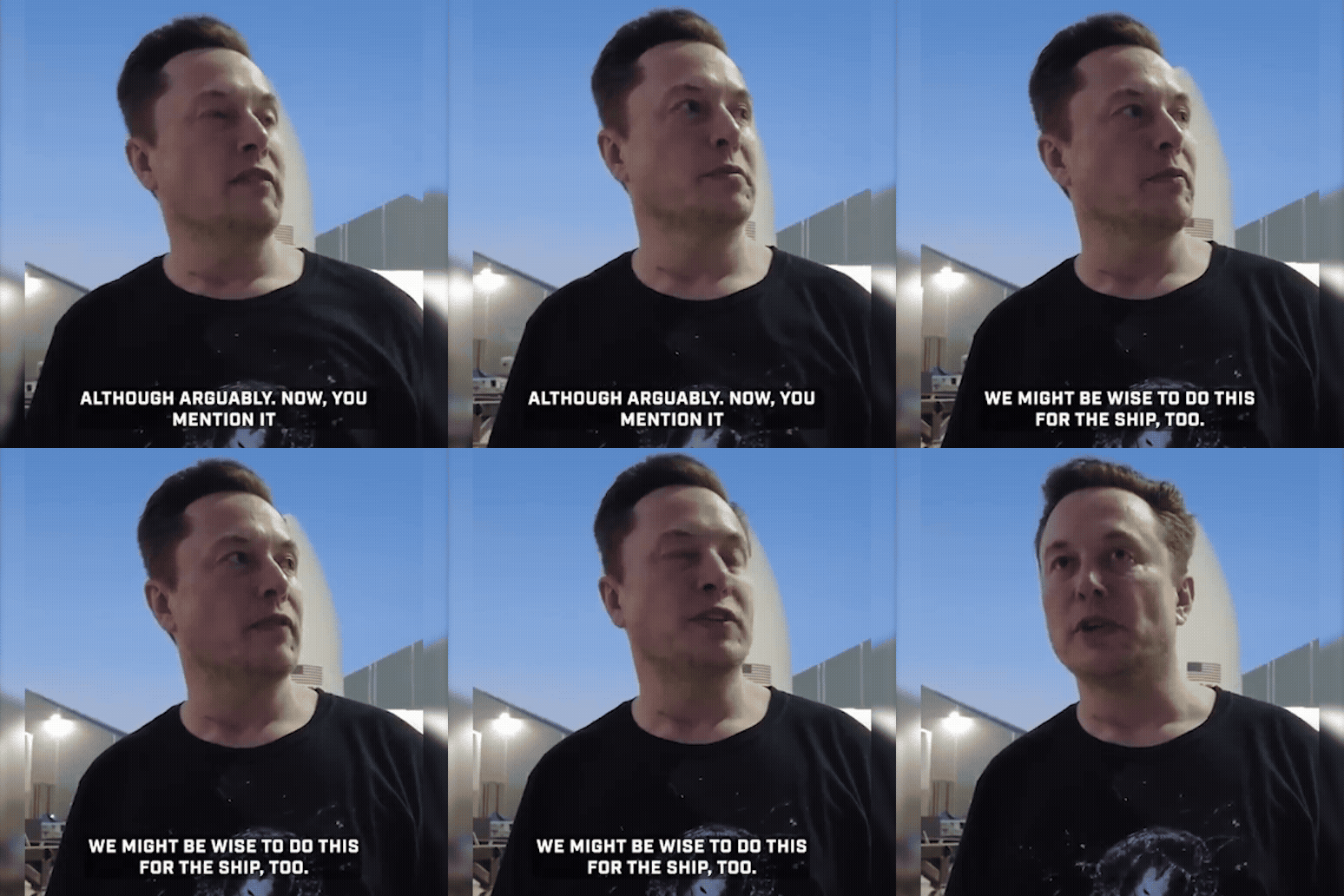
7 months later, Tim came back to visit Elon again. Elon showed him the rocket that had been completely overhauled, and credited Tim's question for the change. Elon described it as one of the biggest improvements they had made.
He said, “it occurred to me while I was explaining it to you.”
Tim’s question wasn't on a list or planned in advance. It came from genuine curiosity in a live, unscripted moment between two humans. It moved one of the most consequential builders in the world to change something he'd already built.
Gold Dust
The insight that Tim uncovered through his questioning is an example of what Eleanor Warnock would call gold dust.Eleanor is Managing Editor at Every, and she joined me on my podcast this week to talk about her recent piece "Socrates as a Service."
In it, she argues that uncovering this gold dust through the process of interviews—or as she calls them, extraction sessions—is now one of the most important parts of the content creation process, and the one thing AI still can't do.
Eleanor defines gold dust as the nugget of insight that lives in someone's head but has never been articulated. It's the thing they mention offhand in the middle of a story, the detail they gloss over because they don't think it's interesting, the idea they've been acting on for years without ever giving it a name.
Eleanor gave me a great example of the work she did with Bek Ventures to build out their content strategy. She sat with their investors and asked open-ended questions: what keeps you up at night, what problems do founders come to you with most? Their answers revealed this clear bit of gold dust: most founder problems are communications problems. She packaged that insight into a simple framework the investors could hand directly to a founder–a clear heuristic that, when something goes wrong in your startup, you first ask whether it's a communications issue, and if not, whether you have the right person in the role. The investors had been using this insight for years without realizing it, and Eleanor turned that gold dust into shareable IP.
Content creation is now easy. So what's actually scarce? It’s the insight that hasn't been expressed, or even thought through yet. It’s the moments that expand the net corpus by adding something genuinely new, rather than rehashing what already exists.
Extraction
Eleanor describes extraction (her interviews) as a very open-ended, sometimes meandering conversation with someone. The goal is to uncover something the other person hasn't quite articulated before.
The interviewer is listening for the thing that wasn't supposed to be the interesting thing. A detail mentioned offhand. A pattern across a few different stories. The thread that, when pulled, leads somewhere neither person expected. She calls it “Socrates as a Service” because the value lies in the human’s ability to probe. It’s an intuition as much as it is a skill.
That intuition is exactly what researchers found AI lacks. In a study published in the International Journal of Human-Computer Interaction, “Unmoderated Usability Studies Evolved: Can GPT Ask Useful Follow-up Questions?”, researchers ran the same conversations with human and AI interviewers. They observed what happened when something unexpected came up. Human interviewers followed the thread. AI moved on.
The person being interviewed usually doesn't recognize what they're saying as the most interesting thing. The instinct that Tim Dodd had with Elon, the thing Oprah does by just asking: "Why?", is what unveils the gold dust.
It’s even more compelling to hear this from Eleanor, because she works at a company that automates as much as humanly possible and reports on frontier AI every day. As a company, Every fully embraces AI. If they could find a prompt that replaced the human interviewer, they would. Yet Every’s published writing is still almost entirely done traditionally. They haven’t found that AI can do it.
For discovery, you still need a human.
The takeaway
Tim Dodd had no idea that question would change a rocket. That's the whole point. The value of a great interview lives in the moments that couldn't have been scripted, being curious enough to follow it, and extracting the gold dust that’s never been put into words before. Great interviewing is still a human job, and it’s something we know really well at Good Content.
.jpg)
.jpg)
.jpg)
%20(1).gif)
.gif)
.gif)
%20(1).gif)

